Prologue: Man, Gold, and Trust
The Oldest Question
Imagine this. You are a farmer. I am a blacksmith from the city. You have wheat. I have a plough. You need the plough. I need the wheat. We meet, we exchange. Problem solved. Economists call this the Barter System.
But what if I don’t need wheat? Or you don’t need a plough? Or we live thousands of kilometres apart?
This is where the question that troubled every civilization was born: How do strangers trust each other?
That one question gave birth to money.
When Trust Got a Shape
Humans first tried to make wheat into money. But wheat rotted. They tried livestock — but animals needed feeding and fell sick. They tried salt — but its availability and price varied everywhere.
Then, slowly, the world began to place its faith in two particular metals: Gold and Silver.
They didn’t rot. They didn’t spoil easily. And they couldn’t be counterfeited without effort. Most importantly — they carried Intrinsic Value. Their worth came not from a king’s stamp or a government’s order, but from the physical quality of the metal itself.
For the first time, humans had something a complete stranger would accept without question. Trust had found a physical shape.
A small but important clarification: this is a simplified model, not a literal historical timeline. In reality, most civilizations ran not on barter but on credit and debt networks — barter tended to appear only when two strangers had no shared record of trust between them. But this model helps us understand the central question this entire series is built around: how does trust acquire a physical — or digital — shape?
But the story didn’t end there.
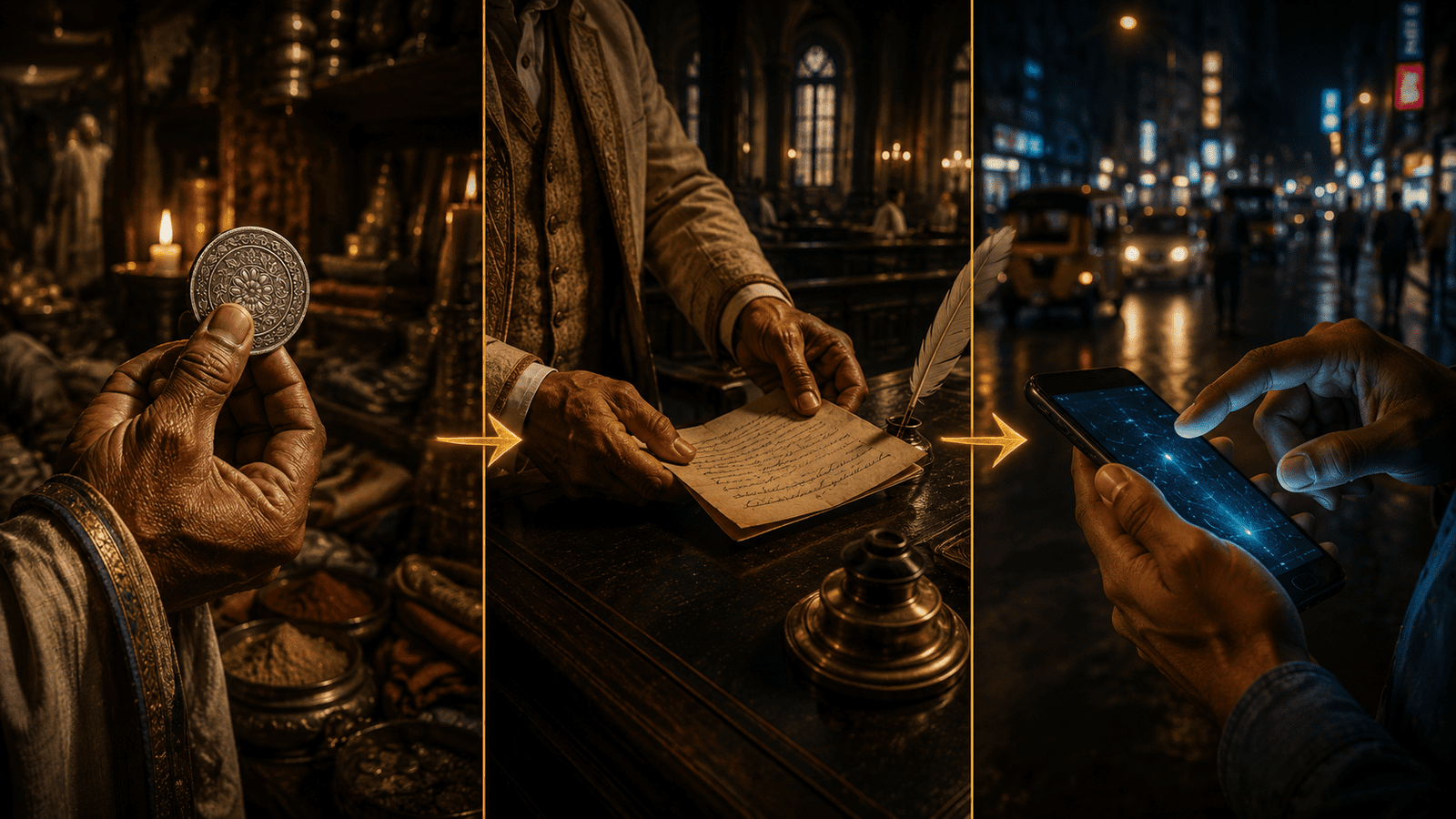
From Metal to Network
As kingdoms grew, as trade crossed oceans, and as caravans crossed deserts, a new problem emerged. Gold and silver were heavy. Transporting them was difficult. They could be stolen, sunk at sea, or looted on the road.
And then humans invented something that seemed to make no sense at all: Paper Currency. A piece of paper with no value of its own — yet people began to trust the promise written on it. Behind that paper stood a merchant’s word, a bank’s guarantee, or a government’s authority. And humanity slowly learned: if a promise is kept, paper can carry more weight than gold.
And gradually, the world arrived at a larger truth: Money was never just gold or silver. Ultimately, money was a system of trust — scarcity, weight, and purity were its tools, not its essence.
Every currency’s story is really a story of trust. Rome’s Denarius. The Spanish Silver Dollar. The British Pound. The American Dollar. And our own — India’s Rupee.
The Rupee’s Story Is Different
But the Rupee’s story is different. Very different. Because this is not just the story of a currency.
This is the story of a country that was once counted among the world’s greatest manufacturing hubs and economies. It is the story of traders and empires, of plunder and reconstruction.
It is the story of hunger, war, oil, gold, and technology. The story of a currency that once drew the world’s silver toward it… then had to quietly pledge its own gold abroad… and today is showing the world new financial rails through digital payments.
What This Series Covers
We will trace this journey across four great Acts — and each Act divide in multiple parts is a complete story in itself.
Act 1 — Rise of the Rupee: The era when India was the world’s workshop. When an Afghan ruler, in just five years of reign, built a monetary standard that even his greatest rivals — the Mughals — ran their entire empire on. When rivers of silver flowed from across the globe into India’s treasuries.
Act 2 — Colonial Economics: When the direction of wealth reversed. The East India Company’s Council Bills, Manchester’s tariffs, Home Charges, Railways’ guaranteed-return model — all the machinations that turned the world’s largest trade surplus into a drain.
Act 3 — Sovereign India: The brutal economic reality check after Independence. Partition, food crises, wars, oil shocks, and that night in 1991 — when the country had to secretly airlift its gold to London just to avoid default.
Act 4 — The Digital Rupee: From paper notes to QR codes. When India decided that financial infrastructure could also be exported — and began showing the world new financial rails through UPI, CBDC, and rupee internationalisation.
A Cup of Chai and Five Centuries
Today, when you scan a QR code at a roadside stall and pay ₹10 for a cup of chai, you are not just making a transaction. You are part of a story that began nearly five centuries ago.
Five hundred years. Empires rose and fell. Coins changed, notes changed, exchange rates changed, technology changed. But one thing never changed. That same question. That same ancient question: How do strangers trust each other?
Rupee Ki Kahani is an attempt to find the answer.
[ The Rupee Story : Part 1 | Part2 ]