“This article is also available in Hinglish — Dollar Ki Kahani Part 1 padhne ke liye yahan click karein”
How a Broke Young Country Created the World’s Most Powerful Currency
Today, the US dollar feels almost untouchable.
Oil is priced in it. Global trade runs through it. Countries hold it in reserves. And whenever there’s a crisis — the world still runs toward it, not away.
But here’s the thing most people don’t know:
America once had no proper currency at all.
No central bank. No unified money. No financial system worth speaking of.
The dollar didn’t start as a superpower.
It started as a mess.
And the story of how it went from that mess to ruling the world — is one of the most fascinating stories in history.
Let’s get into it.
Chapter 1 — Before America Had Money
The 1700s. America isn’t the global giant we know today.
It’s just a bunch of British colonies scattered along the Atlantic coast. No unified government. No real economy. And absolutely no single currency.
People used whatever worked:
British pounds, Dutch coins, local paper notes, Spanish silver coins — and sometimes, believe it or not, tobacco.
Imagine trying to build a serious economy where every region trusts something different. That was America.
Now, the most trusted coin in the world back then wasn’t American. It was Spanish.
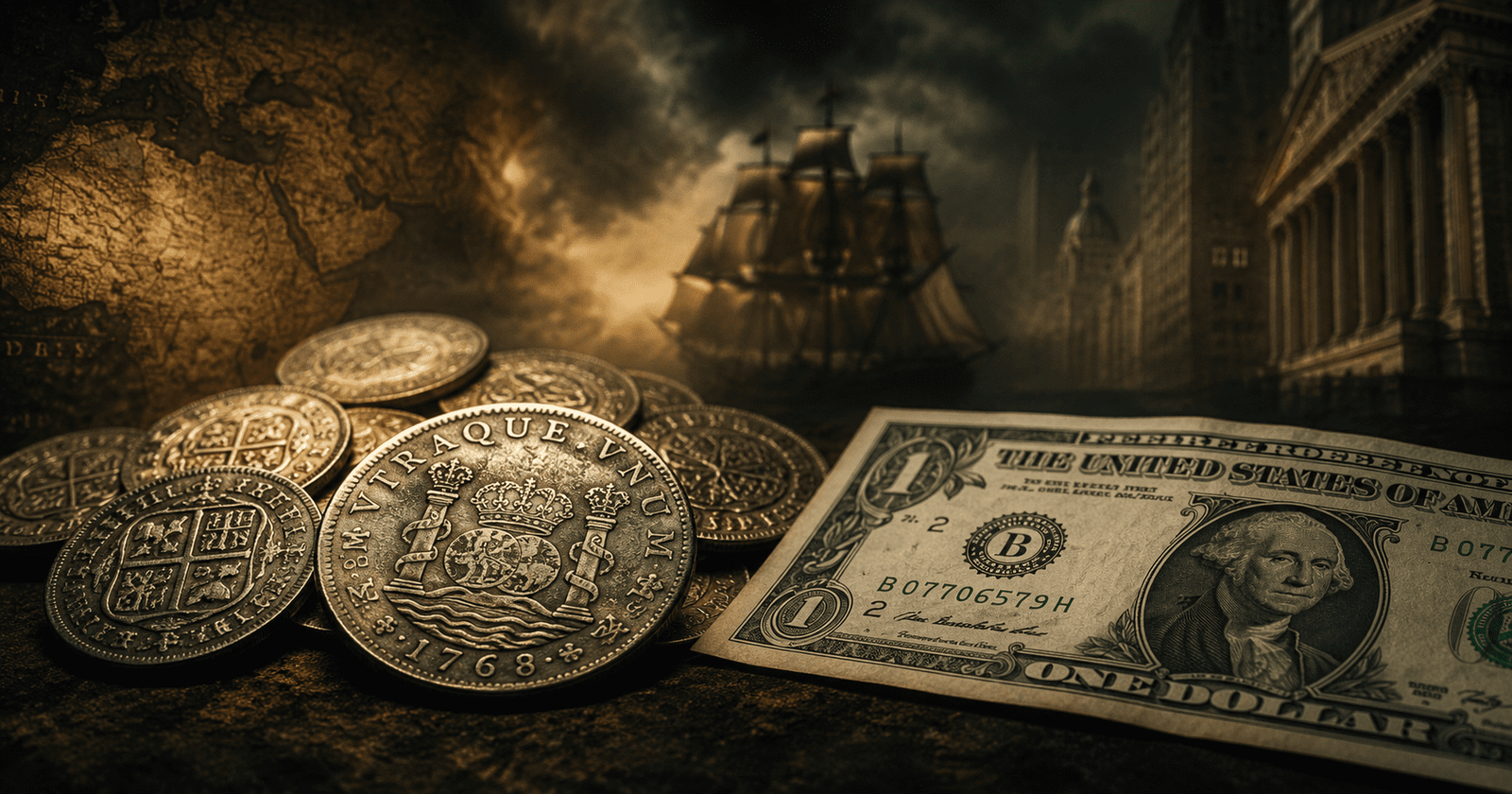
The Spanish Silver Dollar — also called the “Piece of Eight.”
Those coins you see in pirate movies? Real. And genuinely trusted across continents — because they had reliable, consistent silver content. Merchants from London to Canton accepted them without question.
Here’s the fun part: the word “dollar” actually comes from these Spanish coins.
“Thaler” was a German silver coin. The word traveled through Dutch as “dalar,” then into English as “dollar.” The Spanish version of this coin was so popular in colonial America that when the US eventually created its own currency in 1792, they just kept the name.
The future empire borrowed its name from someone else’s coin.
Chapter 2 — The Revolution and the First Financial Disaster
Then came the American Revolution.
Wars cost money. Soldiers need salaries. Armies need food, weapons, supplies. And America had a massive problem — it had none of the financial infrastructure to pay for any of it.
No strong tax system. No central bank. No gold reserves.
So Congress did what desperate governments throughout history almost always do:
It printed money.
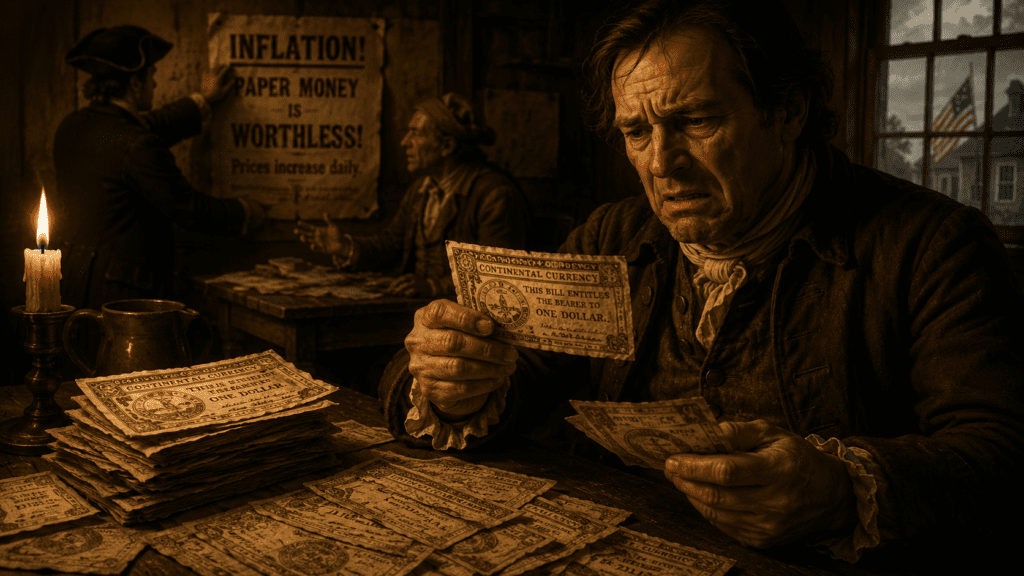
The new paper currency was called Continental Currency.
At first, people used it. But here’s the thing about currencies — they run on trust. And trust is fragile.
America’s government was new, unstable, and financially backing nothing. Too much money was printed too fast. Inflation exploded. The currency collapsed so badly that a common phrase entered the language:
“Not worth a Continental.”
Meaning: completely worthless.
America had learned its first — and most brutal — financial lesson:
Money isn’t paper. Money is belief. And when belief breaks, currencies collapse faster than anyone expects.
This lesson would echo through history over and over again — from Weimar Germany in the 1920s to Zimbabwe in the 2000s. The names and places change. The lesson stays the same.
Chapter 3 — The Man Who Saw the Future
After independence, America was politically free but financially broken.
War debt was enormous. States were pulling in different directions. The economy was unstable. Nobody really trusted the new government’s ability to handle money.
Enter Alexander Hamilton.
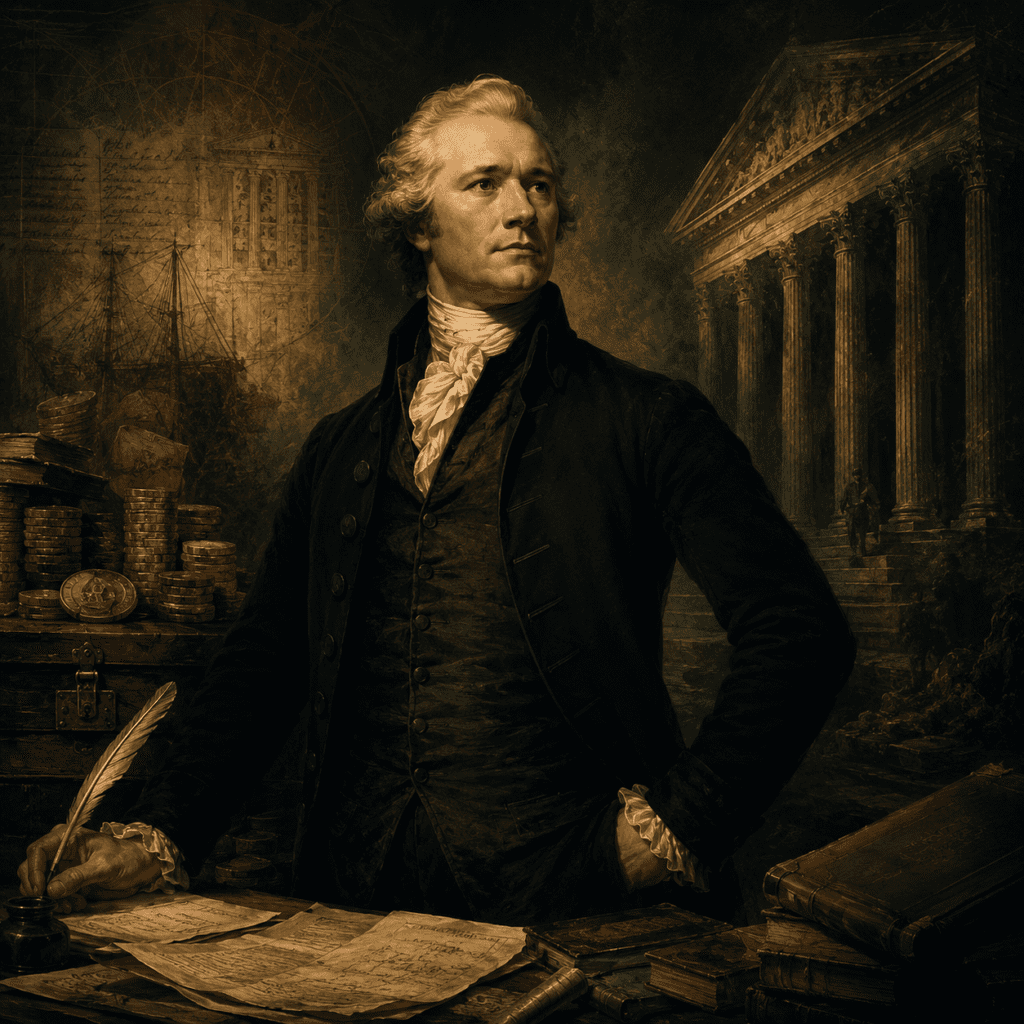
Young, ambitious, and genuinely brilliant — Hamilton understood something most leaders of his time simply didn’t:
A country without financial credibility cannot become a great power.
He pushed for things that were deeply unpopular at the time:
- A national banking system
- Consolidating all war debts under the federal government
- Government bonds to build credibility
- Stronger financial institutions
People hated him for it. Jefferson called his ideas dangerous. Farmers thought he was creating a system that would only benefit the rich.
But Hamilton saw clearly what others couldn’t:
Finance wasn’t separate from power. Finance was power.
He was essentially building the financial architecture of an empire — long before America was one.
In 1792, the Coinage Act officially defined the US dollar. Its silver content was deliberately matched to the Spanish dollar already circulating globally. The message to the world was clear:
“Our money is as reliable as the coin you already trust.”
That signal mattered more than people realized at the time.
Chapter 4 — The Gold Standard and the World That Trusted It
Through the 1800s, something important happened globally.
Country by country, the financial world moved toward what became known as the Gold Standard.
Simple idea: your currency is linked to gold. The government promises that if you show up with paper notes, they can be exchanged for a fixed amount of gold.
This created stability. People trusted it. International trade became easier. Inflation was harder to create out of thin air.
America joined this system too.
But here’s the thing — even with the dollar becoming more credible, the real financial king was still Britain.
The British Pound ruled global finance. London was the center of the economic world. The Bank of England was the most powerful financial institution on Earth.
America was rising. Fast.
But it hadn’t taken the throne yet.
Chapter 5 — Industrial America and the System That Kept Breaking
By the late 1800s, America was transforming at a speed nobody had seen before.
Railroads crossed the continent. Steel empires rose. Oil production surged. Factories multiplied. John D. Rockefeller, J.P. Morgan, Andrew Carnegie — America was building industrial muscle unlike anything the world had seen.
But beneath all that growth, the banking system kept breaking.
Financial panics hit roughly every decade. Whenever fear spread — banks collapsed, credit disappeared, businesses shut down. Between 1863 and 1913, there were at least 8 major banking panics. (Source: Federal Reserve History)
Then came 1907.
The Knickerbocker Trust Company in New York collapsed. Panic spread through the financial system at alarming speed. Banks froze. The economy teetered.
And here’s what saved it: not the government. Not any institution.
J.P. Morgan personally called the shots. He locked the most powerful bankers in his library and refused to let anyone leave until they’d agreed to pool money to stabilize the system. The man single-handedly stopped a financial collapse.
It worked. But it left everyone unsettled.
The stability of the world’s fastest-growing economy depended on one private citizen’s willingness to step in?
That clearly couldn’t continue.
Chapter 6 — The Federal Reserve: America Gets Serious
In December 1913, Congress passed the Federal Reserve Act.
America finally had a central bank.
The Federal Reserve — or “the Fed” — became the backbone of the American financial system. Its job:
- Manage money supply
- Stabilize banks during crises
- Provide emergency liquidity
- Reduce the chaos that had plagued American finance for decades
It wasn’t universally loved. Critics called it a banker’s conspiracy. Some called it unconstitutional.
But it worked.
And over time, it would become one of the most powerful financial institutions ever created. Today when the Fed changes interest rates, stock markets in Tokyo, London, and Mumbai react within minutes.
That’s how powerful the system eventually became.
But in 1913, America was still preparing for something much bigger.
Chapter 7 — World War I: The Power Shift Nobody Noticed in Time
1914. World War I begins.
Europe descended into destruction on a scale never seen before.
Britain, France, Germany — the major powers — accumulated massive war debts, lost gold reserves, and came out economically battered.
Meanwhile, America did something different.
It supplied. Weapons, industrial goods, food, loans. Enormous amounts of all of it. And payment flowed back — often in gold.
Gold reserves gradually shifted from Europe to America.
London’s grip on global finance began loosening. New York started emerging as an alternative center of power.
It wasn’t dramatic. Nobody announced it. But the financial center of gravity of the world was quietly moving west.
History often works this way. Empires don’t always announce their arrival. Sometimes power shifts through trade routes, debt flows, and capital movements — and people only recognize it years later.
Chapter 8 — The Great Depression and the Dark Side of Money
1929. The stock market crashed.
The Great Depression hit the United States like a wrecking ball — and then spread to the rest of the world.
Banks failed. Businesses collapsed. Unemployment in the US hit 25%. People stood in bread lines. Millions lost everything.
Fear made it worse. People rushed to withdraw their money and gold from banks. Banks that were fine became unstable. Panic became self-fulfilling.
In 1933, President Franklin D. Roosevelt took dramatic action:
- Private gold ownership was effectively banned
- The government consolidated gold reserves
- The dollar was devalued — gold price set at $35/oz under the Gold Reserve Act of 1934
- The FDIC was created — if your bank failed, the government would now protect your deposits
The goal: restore trust. Stop the panic. Get the system working again.
It worked — but it revealed something important:
In extreme crises, governments change the rules. Always. The definition of “money” is never as fixed as it seems.
Chapter 9 — Bretton Woods: The Moment Everything Changed
July 1944. World War II is almost over.
Everyone knows the Allies will win. The question isn’t if — it’s what comes next.
Representatives from 44 countries traveled to a hotel in Bretton Woods, New Hampshire. 730 delegates. Three weeks of negotiations.
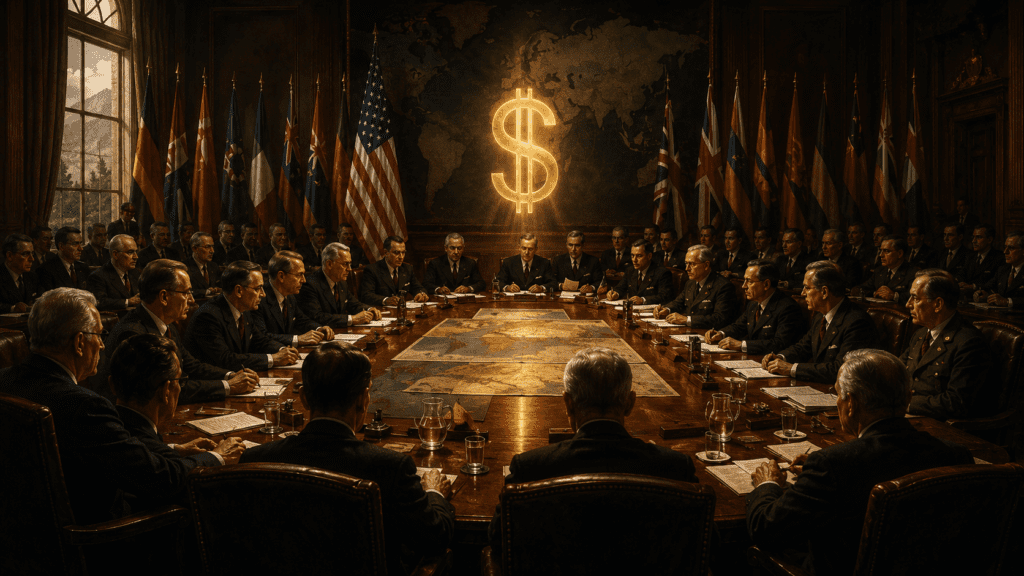
They were designing the post-war financial order from scratch.
The result — the Bretton Woods Agreement — was simple in structure but enormous in consequence:
- The US dollar would be linked to gold at $35 per ounce
- Every other major currency would be pegged to the dollar
- The International Monetary Fund and World Bank would be created to support the system
Why the dollar?
Because America had:
- The strongest economy on Earth
- Two-thirds of the world’s gold reserves sitting in Fort Knox (Source: Bretton Woods Committee)
- The least war damage of any major power
- The most credible financial institutions
The New York Times reported on July 23, 1944:
“The American dollar thus obtains international recognition, on paper as in fact, as the world currency.”
This was the turning point.
The dollar stopped being just America’s currency.
It became the world’s currency.
Ending — But This Was Just the Beginning
The dollar didn’t become powerful because America printed more paper.
It became powerful through a combination of:
- Wars that weakened everyone else
- Gold that flowed toward America
- Financial institutions that built credibility
- Industrial dominance that created real economic power
- And a 1944 conference where the world formally agreed: the dollar is the anchor
By 1944, the foundation was laid.
But the real story was still ahead.
Because in the decades that followed — oil, geopolitics, a president’s Sunday night TV address, and a secret deal in the desert — would take the dollar from “world’s currency” to something even more powerful:
The operating system of the modern world.
That story is in Part 2 — How the Dollar Became King.
Key Terms
Gold Standard: A monetary system where currency value is directly linked to gold. Governments promised to exchange notes for gold on demand.
Continental Currency: Paper money printed during the American Revolution. Collapsed due to inflation and loss of public trust — giving rise to the phrase “not worth a Continental.”
Federal Reserve: The central banking system of the United States, created in 1913. Manages money supply, sets interest rates, and acts as lender of last resort during crises.
Bretton Woods System: The post-WWII global monetary framework where major currencies were pegged to the US dollar, and the dollar was pegged to gold at $35/oz.
Reserve Currency: A currency held in large quantities by central banks and governments worldwide for international trade and financial stability.
Coinage Act of 1792: The law that officially established the US dollar and defined its silver and gold content.
FAQ
What was the Bretton Woods agreement?
In July 1944, representatives from 44 countries met at a hotel in Bretton Woods, New Hampshire to design the post-war global financial system. The main decision: the US dollar would be linked to gold at $35 per ounce, and all other major currencies would be pegged to the dollar. The IMF and World Bank were also created. This is the moment the dollar officially became the world’s financial anchor.
Why did the US abandon Bretton Woods?
Through what became known as the Nixon Shock in 1971. By the early 1970s, Vietnam War spending had created enormous deficits, US gold reserves were falling dangerously low, and European countries were showing up demanding gold for their dollars. Nixon suspended dollar-gold convertibility on August 15, 1971 — calling it “temporary.” It was never reversed.
What are the 5 key elements of the Bretton Woods system?
1. The US dollar was pegged to gold at $35 per ounce.
2. All other major currencies were pegged to the dollar within a 1% band.
3. The International Monetary Fund was created for emergency financial support.
4. The World Bank was created for reconstruction lending.
5. A fixed exchange rate system that gave global trade stability for nearly three decades.
Why did the Continental Currency fail?
Because it had no strong backing — no gold, no stable government, no public trust. When Congress printed too much too fast to fund the Revolutionary War, inflation exploded and the currency became worthless. It gave rise to the phrase “not worth a Continental” — meaning completely valueless. The same lesson has repeated throughout history, from Weimar Germany to Zimbabwe.
What did Alexander Hamilton do for America’s financial system?
Hamilton designed America’s financial architecture from scratch — pushing for a national bank, consolidating war debts under the federal government, creating government bonds, and building financial credibility. He understood that finance was power, not just accounting. Without his vision, America likely never becomes a global power. He was building the foundations of an empire before America even knew it was becoming one.
Sources
- Spanish Dollar — Wikipedia: https://en.wikipedia.org/wiki/Spanish_dollar
- History of the US Dollar — Everything Everywhere: https://everything-everywhere.com/the-history-of-the-dollar-as-a-currency/
- Federal Reserve Created — Wikipedia: https://en.wikipedia.org/wiki/Federal_Reserve
- Panic of 1907 — Federal Reserve History: https://www.federalreservehistory.org/essays/panic-of-1907
- Banking Panics — Federal Reserve History: https://www.federalreservehistory.org/essays/banking-panics-of-the-gilded-age
- Bretton Woods — Federal Reserve History: https://www.federalreservehistory.org/essays/bretton-woods-created
- Bretton Woods — Why the Dollar: https://brettonwoods.org/bretton-woods-why-the-dollar/