
When the World Brought Its Silver to India’s Door
Quick Answer: In the 17th century, India was one of the world’s largest manufacturing centers, textiles, spices, steel, all of it. Europe had little worth offering India in return, so payment came in silver instead. The mines of the Americas, Japan’s silver, and the trade routes of the Levant, silver kept flowing into India’s treasuries through these three routes, until a private company asked a different question: why send silver at all?
Before you read this article: In Part 1, we saw how Sher Shah Suri gave the Rupiya a trusted standard. Now let’s look at how the entire global economy operated behind that standard. And yes, this is exactly where strength and weakness end up sitting on the same line.
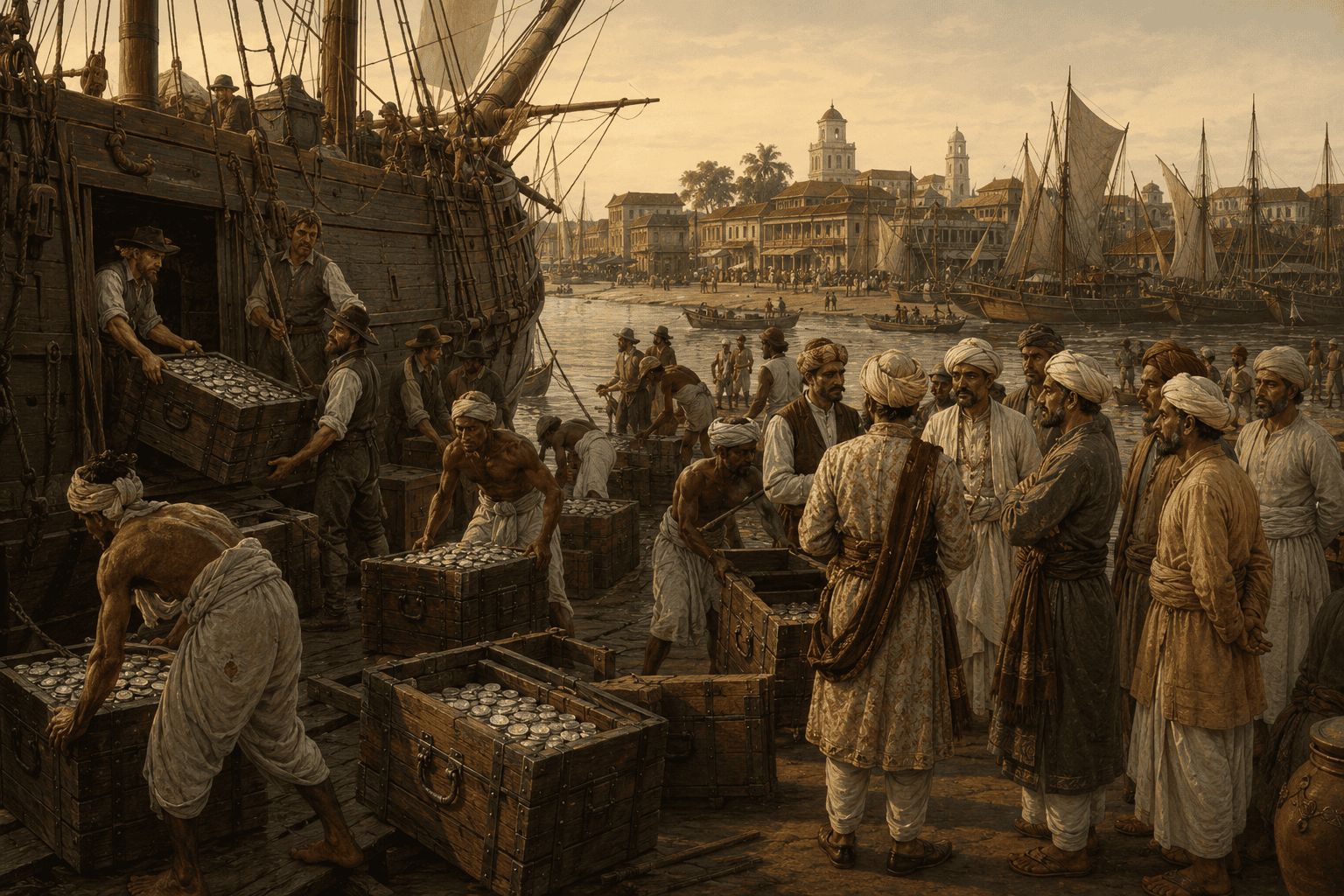
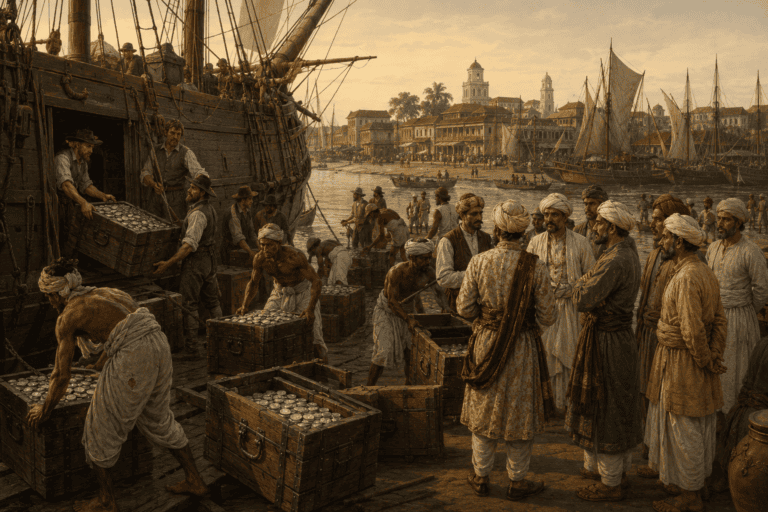
Let me take you to the port of Surat in the 17th century. A European ship arrives and drops anchor here, and you might think it’s carrying cloth, or machinery, or precious stones, but it isn’t. What it’s carrying is silver coins. This ship hadn’t come to sell anything. It had come to buy.
In the 17th century, India was one of the world’s largest manufacturing centers. Textiles, spices, and steel from India were exported across the globe, and all of it was paid for in silver. Silver was flowing into India’s treasuries through three routes: the mines of the Americas, Japan’s silver, and the trade routes of the Levant (the Middle East).
The Indian Ocean’s Highway
When I studied history in school, it seemed like Vasco da Gama had connected India to the world. But that wasn’t true, because centuries before the Portuguese first arrived in the Indian Ocean, it was already one of the busiest commercial highways in existence. Arab merchants traded horses, dates, and pearls along this route, while Gujarati traders carried cotton textiles from Surat all the way to East Africa.
Hormuz, Aden, Calicut, Malacca, Quanzhou, these weren’t just ports, they were nodes in a network that no single empire controlled. Today we’d call that decentralized. Back then, people simply called it commerce.
When the Portuguese arrived in India, they didn’t create anything new, they entered a network that already existed. And when they saw that the biggest manufacturing hub in this network was India, they began trading with India too. But their ships also carried cannons, so they brought power along with trade, and that was something entirely new for the Indian Ocean.
Murshidabad’s Loom
A house in Murshidabad, a weaver sitting in front of his loom. There’s no smoke-belching chimney in this house, no machine making noise, just an old wooden loom, some thread, and a skill built into the hands over years. If someone looked at it from outside, they might not even realize anything significant was happening there. But the cloth being woven in that small room had buyers thousands of kilometers away, in places like London and Amsterdam. That Murshidabad weaver’s marketplace was the entire world. Sometimes I think we make this idea sound new by using fancy words like “global supply chain,” when the truth is, this thread connecting the world had been running for centuries.
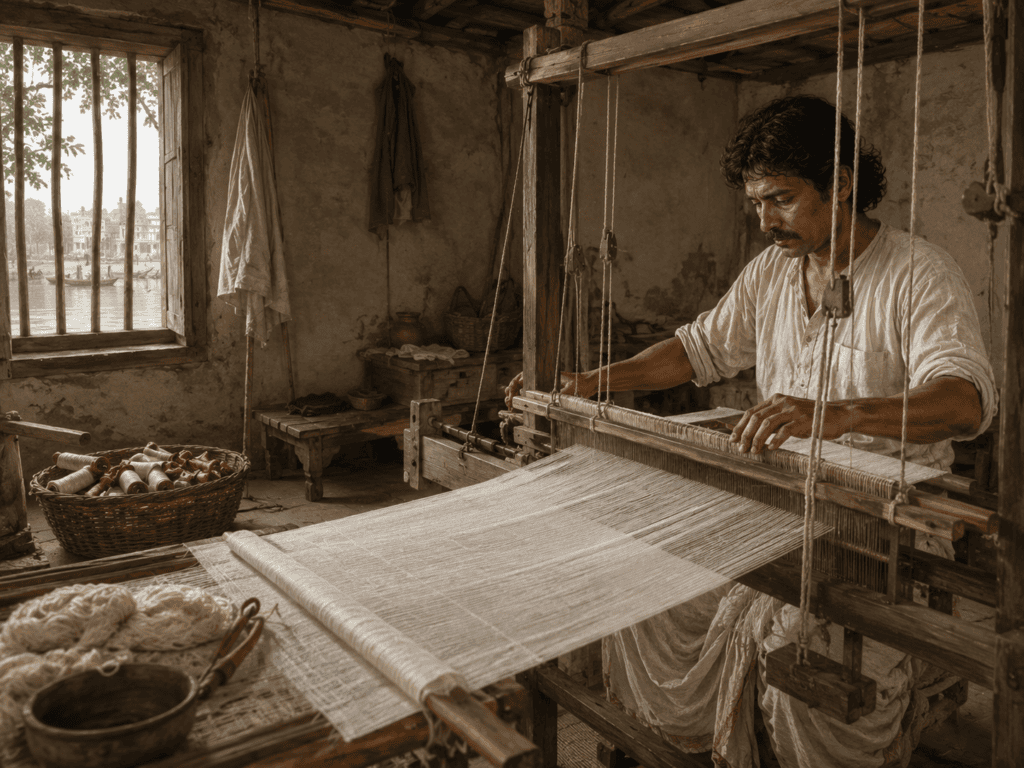
In the 17th century, Indian cotton textiles were a technological marvel to the world. Europeans mostly wore wool, which was hot and heavy, and hard to wash.
Indian cotton, on the other hand, was light and comfortable, and it could be washed easily. Then came muslin, so fine that European travelers wrote that a whole piece could be pulled through a finger ring. Then came calico, sturdy and cheap, with colors that didn’t fade even after repeated washing.
The French textile industry saw this as a threat and banned Indian cotton imports, and England followed soon after. The Calico Act came in 1700, and a stricter version in 1721. That ban itself was the biggest proof of how competitive Indian textiles were. When something is good enough that a law has to be passed to stop it, that alone tells you how much market pressure it was creating.
A big question arises here: if Indian textiles were this popular, why didn’t Europe just copy them? Simple, the Industrial Revolution hadn’t happened yet, and European cotton manufacturing wasn’t anywhere close to Indian craftsmanship. Spinning, weaving, dyeing, at every step, Indian artisans had a skill that came from years of training, not from machines. Manchester’s mills, which would later ruin Indian weavers, didn’t even exist until the end of the 18th century.
And it wasn’t just about cloth. South India’s pepper reached the kitchens of Europe’s wealthy households. European textile industry was hard to imagine without indigo. India’s Wootz steel was so famous that you couldn’t talk about Middle Eastern swords without mentioning it. And saltpeter? That was the essential raw material for making gunpowder. At the time, it was considered a strategic commodity.
Back then, India wasn’t known just for the fact that things were made here, it was known for the fact that good things were made here. If a country today is remembered for high quality manufacturing, India had a similar kind of reputation in that era. And the most interesting part was that none of this was happening inside one big factory, every village, every town had its own role.
In one place people were spinning thread, in another dyes were being prepared, and somewhere else a loom was running. A merchant would come with an order, a broker would coordinate in between, an artisan would do the work, and the accountant, the shroff, would keep the books. In the end, that same product would travel thousands of kilometers and get sold in some other corner of the world. And all of this was happening when there was no multinational company and no global logistics giant.
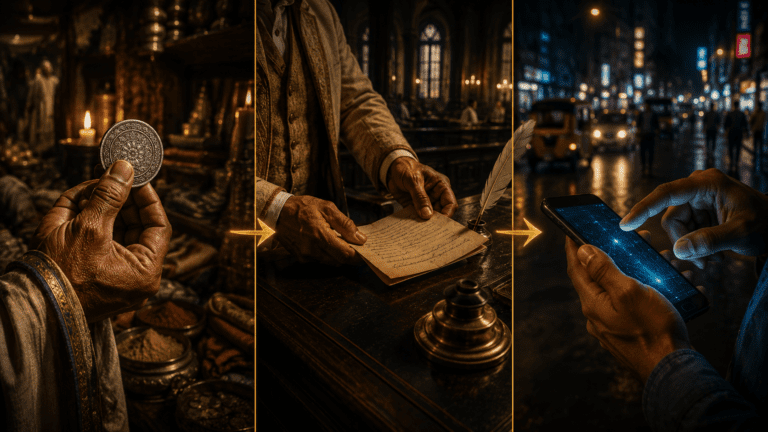
Today, when we need to track an order, we just open our phone and check where the parcel has reached, but back then, once a ship left, all you could do was wait for months, and yet trade ran globally on nothing but trust.
Where the Silver Came From
In the 16th century, the Spanish Empire found the world’s largest silver mines, in a mountain in today’s Bolivia called Potosí. This treasure changed the global economy itself, but behind this glittering silver lay a very deep darkness. Thousands of indigenous workers and African slaves were lowered hundreds of feet underground every day to mine that silver. Down there, every single day carried a risk, darkness, suffocation, and mercury poisoning. Many men started work down there and never came back out.
This place became such a massive symbol of wealth that a Spanish phrase emerged during that era, “Vale un Potosí” (meaning something so valuable that nothing else compares). Even the famous novel Don Quixote makes a mention of it.
Between 1545 and 1800, roughly 40,000 metric tonnes of silver were extracted from Potosí. Mexico’s Zacatecas and Guanajuato weren’t far behind in this race either. Within just a few years, Europe had more silver than it had ever dreamed of.
But the real twist in this story comes now.
The first time I read about this, I assumed Europe must have used all this silver itself. But the truth is, a very large share of this silver never stayed in Europe at all.
Its real destination was Asia.
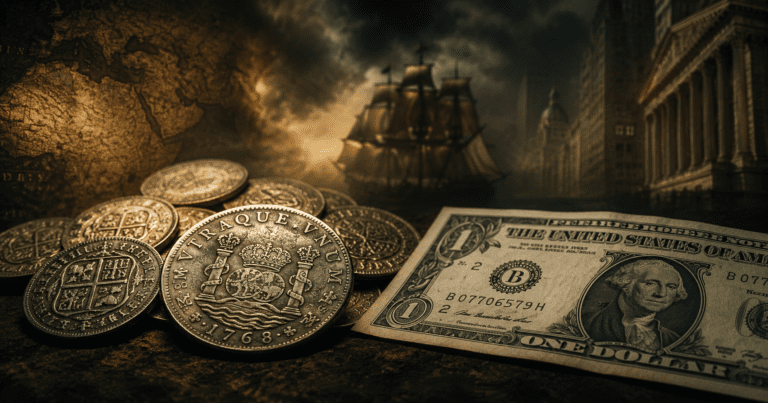
Silver would leave the Andes Mountains, go first to Spain, then pass into the hands of merchants in Amsterdam or London, and then make the long, dangerous sea voyage around the Cape of Good Hope to reach us here, Surat, Agra, Dhaka, and Murshidabad.
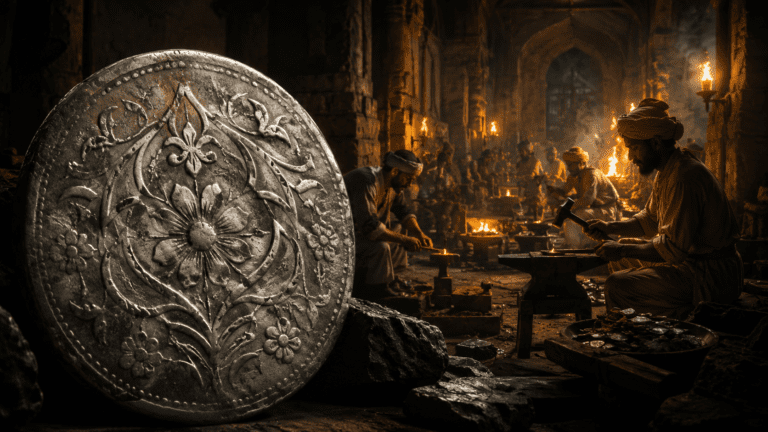
This entire network was like something out of a blockbuster movie. Silver from the mines of the Americas would pass through Spain, reach the Levant (the Middle East) via European merchants, and from there travel by land or sea to India. On the other side, Japanese silver was being brought in by Dutch traders. When this foreign silver reached the imperial mints (taksal) of Surat, that molten silver was cast into Mughal coins.
Historian Najaf Haider estimates that between the 1580s and 1680s, Mughal mints absorbed roughly 240 million rupees worth of bullion (silver blocks).
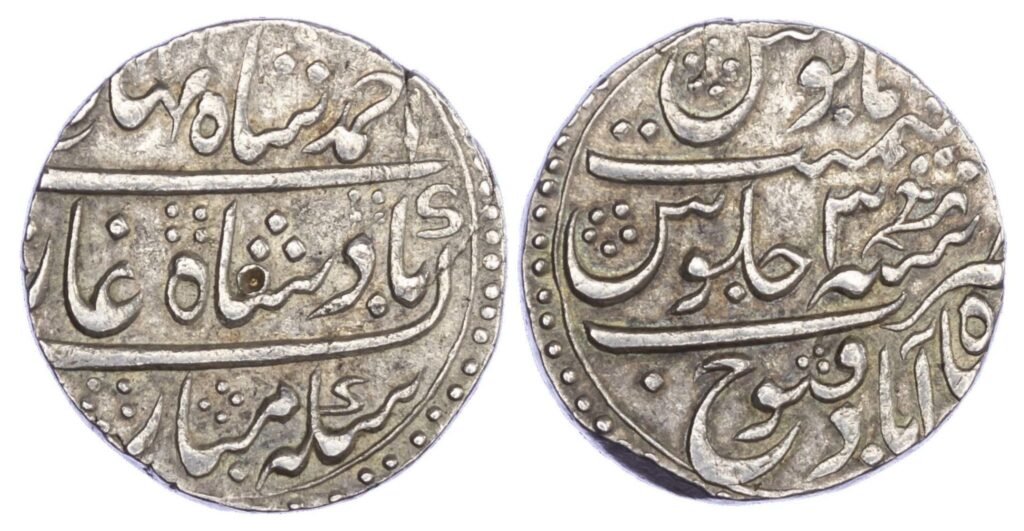
The world’s largest destination for silver was Ming China, and right after it, in second place, was Mughal India. And being in second place in that era was no small thing. This is exactly why economic historians call India and China “Silver Sink Economies,” meaning places where all the world’s silver arrived and simply settled.
Silver and the Rupiya
Now the question was, what happened to all that silver.
Did it just sit locked away in the treasuries of kings? Not at all.
The Rupiya standard that Sher Shah Suri had started had, by the Mughal era, become the common currency of all of Hindustan. And now that system was receiving silver from across the world.
Once it arrived here, silver didn’t remain just a metal. It became the Rupiya.
And the Rupiya wasn’t just a coin either. The common man paid his taxes in it, and soldiers were paid their wages in it. Everyday trade in the bazaar ran on its trust too. From the marketplace all the way to government accounts, everything revolved around it. New coins were minted, farmers paid land revenue, merchants settled their accounts, goldsmiths made jewelry from that very silver. In many homes, savings were also kept in the form of silver.
So India’s strength didn’t lie merely in the fact that silver was arriving here. The real point was that the entire system needed to put that silver to use was already in place, a trusted currency, a strong merchant network, an established credit system, and manufacturing famous the world over.
Sometimes I think we treat gold and silver themselves as the whole secret to a country’s wealth. But history says something else. If silver alone guaranteed lasting prosperity, Spain would never have lost its economic lead. The real difference lies less in the metal and more in the institutions that manage that metal.
Europe’s Frustration
This is exactly where Europe’s problem begins.
European merchants wanted India’s goods, and wanted them badly. But they had little worth offering in exchange. And remember, Europe wasn’t India’s only customer.
Indian cotton was already selling in the markets of Java and Sumatra. The Persian and Ottoman Empires were major buyers of Indian textiles and indigo. East Africa’s ports, Mombasa, Kilwa, and Zanzibar, had been connected to Gujarati trading networks for centuries. From Malacca to Batavia, Indian cloth was a regular trade item. Europe arrived late to this story.
The 17th century French traveler François Bernier wrote in his travel account that gold and silver were drawn from every corner of the world into Hindustan. This wasn’t just his personal impression, several trade records and European travelers from that era point to the same pattern.
The trouble was that European cloth wasn’t better than Indian cloth. Their handicrafts couldn’t easily compete with Indian craftsmanship either. In the end, the most reliable method of payment that remained was silver.
At the time, Mercantilism was a fairly popular economic philosophy in Europe. The logic was simple, whichever country held more gold and silver would be the wealthier one. So every government wanted to keep precious metals within its own borders.
Now think about their problem. Every year, ships were arriving in India loaded with silver. They were leaving loaded with cloth, spices, and indigo. The silver wasn’t coming back.
If this went on for a year or two, maybe no one would worry. But when this pattern repeats for decades, questions start to arise. And when trade itself can’t solve the problem, people start looking at options outside trade.
The Question That Changed History
For a moment, put yourself in the shoes of a director at the East India Company. Two paths lay ahead.
The first, send silver from London every year, use it to buy Indian goods, and sell them in Europe for a profit.
The second, find a source right inside India from which money could be raised. Then there would be no need to send silver from London at all. Buy Indian goods with Indian revenue and sell them in Europe.
The more you think about it, the more you realize how powerful that second option was.
It wasn’t just a way to cut costs. It was a formula for changing the entire flow of global wealth.
And the gaze behind this formula settles on Bengal.
At the time, Bengal wasn’t just another province. It was one of the wealthiest regions of the Mughal Empire. Cloth, rice, sugar, saltpeter, fertile land, a network of rivers, and an enormous revenue base. If a merchant gained control over that revenue, why would there be any need to send silver from London at all? That same money would circulate within India. It would be used to buy Indian goods, which would then be shipped off to Europe.
To hear it, this might sound like nothing more than an accounting trick. But this exact line of thinking changed the course of economic history.
For two centuries, silver had been flowing toward India. Now, for the first time, someone thought about changing the very path of that flowing money. And this story didn’t begin with a sword. It began with bookkeeping and with cold calculations of profit.
Read next, Rupee Ki Kahani Part 3, Bengal, The Richest Province, coming soon.
FAQs
Q1. Who traded in the Indian Ocean before Vasco da Gama?
Arab merchants, Gujarati traders, Tamil seafarers, Chinese and Malay sailors, all of them had been on the Indian Ocean highway for centuries. Europe didn’t create global trade, it entered a network that already existed.
Q2. Why did Europe pay India in silver?
India had everything the world wanted, textiles, spices, steel. India had little interest in Europe’s manufactured goods. So there was only one currency of payment left, silver.
Q3. Where is Potosí, and what’s its connection to the Indian economy?
It’s in present day Bolivia. In the 16th century, the Spanish Empire discovered the world’s largest silver mines there. The silver extracted there eventually traveled through Europe and reached India as payment for Indian textiles and spices.
Q4. Was India wealthier than Europe before British rule?
India was one of the largest economies and manufacturing centers of that era. But a direct comparison of “wealthier than Europe” is difficult, Europe was made up of many separate states, and the metric used matters. What’s clear is that in terms of manufacturing output and scale of trade, 17th century Mughal India was not behind any European nation, though comparing per capita income is a different story.
2 Comments