
When India Gave Money a Standard
Quick Answer: The Rupee’s foundations were laid in the 1540s by Sher Shah Suri, who introduced a fixed 178-grain high-quality silver coin called the Rupiya. Mughal Emperor Akbar (1556–1605) adopted and refined this system, making the Rupee the most widely accepted silver standard across the Mughal Empire — roughly 250 years before the American Dollar existed.
A Street Stall, A Transaction, A Question
Yesterday evening. A roadside stall, a cup of cutting chai, and a QR code. Took out the phone, scanned it — ₹10 transferred. No names exchanged, no verification asked. Transaction done in a second.
Think about it — I didn’t know that man. He didn’t know me. And yet we both trusted each other completely, without a second thought.
Every day we say or think the word “Rupee” dozens of times. But we rarely stop to ask — how do we all place blind trust in a piece of paper or a digital number? Because the trust happens so naturally that the question never even arises.
But what happened when there was no system? No central standard, no common currency?
To understand that, we need to go back to the 16th century.
When Money Was a Physical Thing
How did currency work before the Rupee?
Today’s ₹500 note is, at its core, just a piece of paper — it has no value of its own. In economics we call this Fiat Currency. The government declared it valid, everyone agreed, and so it works. Government backing, the RBI Governor’s signature, and collective trust — these three things are what make that note valuable.
Thousands of years ago, this luxury didn’t exist.
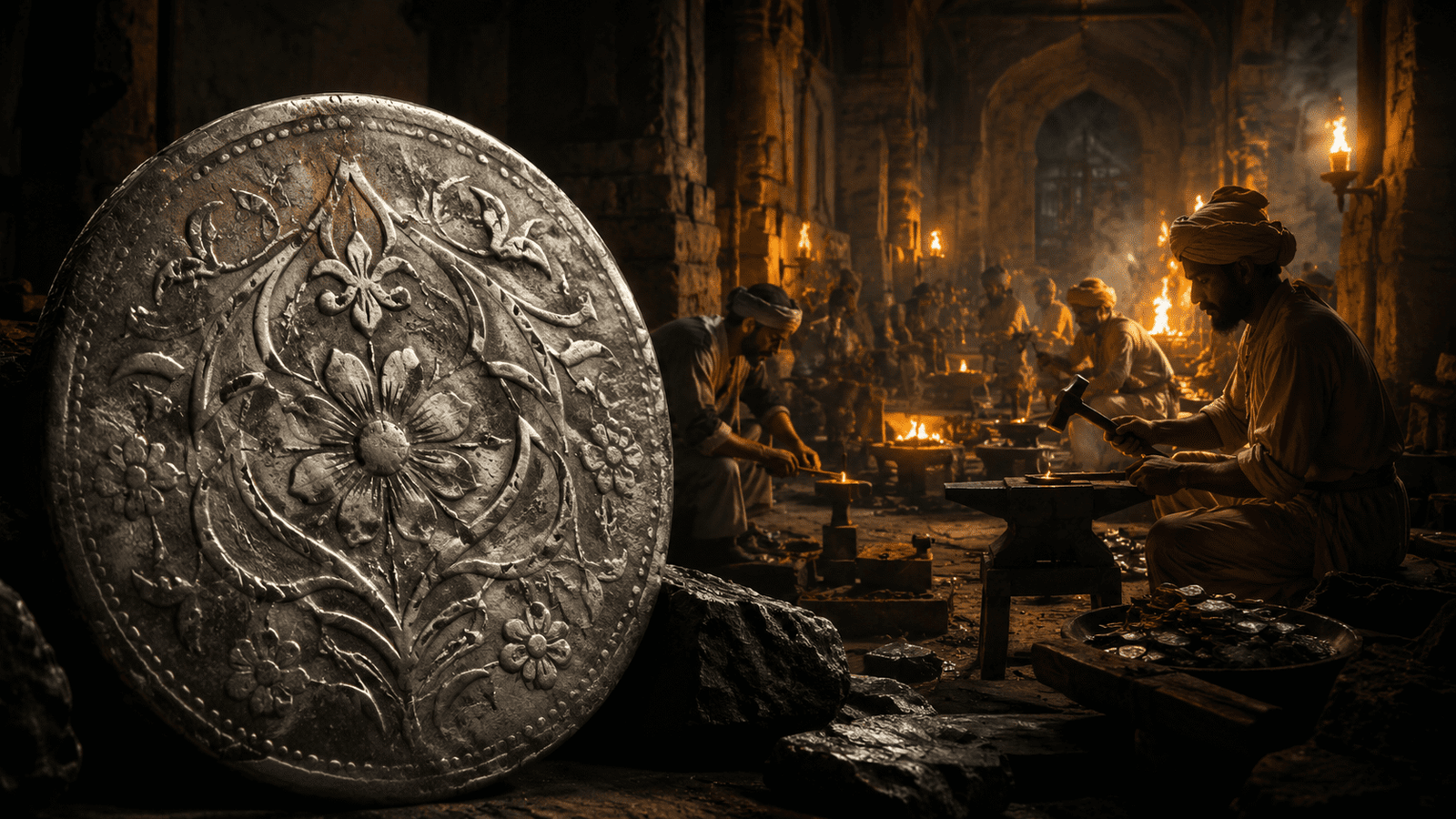
Currency meant actual Gold, Silver, Copper. The worth of any coin was determined by how much silver was packed into it — not by a king’s stamp or government order, but by the metal’s own Intrinsic Value. Value wasn’t externally assigned. It was internally embedded.
In ancient India, every kingdom ran its own game. Punch-marked coins from the Purana era, silver coins from the Mauryan Empire, gold dinars from the Gupta dynasty — all magnificent in their own right, but also a massive operational headache. Every kingdom had its own weight system, every ruler his own standard, every market its own exchange rate.
Think about it — if Delhi’s ₹100 note became invalid the moment you crossed into Mumbai and you had to buy a local note after paying commission — how would business work? Long-distance trade in 16th-century India was expensive for exactly this reason. Before any major deal, merchants had to weigh coins, check silver purity, and argue over exchange rates for hours.
When currency creates confusion, transactions slow down. Slow transactions push up costs, and higher costs kill growth.
16th-century India was trapped in exactly this problem — until someone arrived who changed the country’s entire monetary architecture.
What Did Sher Shah Suri Do That Nobody Else Could?
How did Sher Shah Suri standardize the Rupiya?
A new Afghan ruler sat on the throne of Delhi — Sher Shah Suri. His reign lasted just five years (1540–1545). Schools remember him for renovating the Grand Trunk Road and building its sarais — a genuine contribution. But his greatest masterstroke wasn’t in transport.
It was monetary architecture.
One thing needs to be clear — Sher Shah didn’t invent the word “Rupiya.” It comes from the Sanskrit “Rupya,” meaning wrought silver. The name already existed, being used here and there. What he did was far bigger — he took a floating, regional, inconsistently used name and turned it into a fixed, empire-wide standard. The difference is like that between a village elder’s word and a king’s royal seal — the elder’s word runs only as far as his village, but the king’s seal is accepted everywhere, without question.
This is why many historians consider Sher Shah’s Rupiya to be the direct ancestor of the modern Indian Rupee.
His system rested on three pillars.
First — weight precision. Every Rupiya weighed exactly 178 grains, roughly 11.5 grams of high-quality silver. Such precision that a merchant sitting hundreds of miles away would accept a coin without weighing it — because he knew the mint had never compromised. This was the policy. In practice, mint-to-mint variation and some debasement continued under later rulers — but the benchmark held.
Second — state control. The right to mint coins was taken away from local goldsmiths and given directly to state-controlled mints. No room for adulteration.
Third — a full economic architecture. Gold Mohur for large transactions, Silver Rupiya for everyday commerce, Copper Dam for small daily expenses. A different metal for every layer of the economy.
Here’s the thing that genuinely surprises me — his reign was just five years. And in those five years he built a monetary framework that his greatest rivals — the Mughals, who never politically acknowledged him — ran their entire empire on. Popular culture doesn’t give him a full chapter. But the foundation was his.
What Did Standardization Actually Mean?
Why did monetary standardization matter for the economy?
This was not just a coin reform. It was a Trust Reform.
Think about it — before standardization, every transaction carried an invisible tax. Time spent weighing. Time spent checking purity. Time spent arguing over exchange rates. All of this combined to make trade slow and expensive.
After Sher Shah? A merchant from Bengal could deal with a merchant from Punjab — and both knew exactly what a Rupiya in their hand was worth. No argument, no verification. Straight business.
When this friction was removed from millions of transactions, the economy began moving at an entirely different speed. Standardization wasn’t just convenience — it was an engine of growth.
Why Didn’t Akbar Dismantle the System?
Why did the Rupee-to-Dam ratio change during Akbar’s reign?
Sher Shah’s empire ended with his death. But his monetary framework was so solid that his greatest rivals — the Mughals — didn’t touch it.
When Emperor Akbar (1556–1605) expanded the Mughal Empire across the subcontinent, he adopted and refined the same Rupiya system. The Ain-i-Akbari contains detailed mint records — this was no accident. It was deliberate continuity.
But the Rupee-to-Dam ratio was never fixed — and this is what most people miss.
This was a Bimetallic System — silver and copper both circulated together, but their exchange ratio floated with market forces. The official standard in the Ain-i-Akbari was 1 Rupee = 40 Dam. Abul Fazl himself recorded the 1595–96 exchange rates:
“One muhr equalled 9 rupees and one rupee was equivalent to 40 dams.” — Abu al-Fazl, Ain-i-Akbari (1595–96)
On the ground, depending on copper supply and regional market conditions, this ratio swung between 38 and 42 Dam — without any royal decree, without any announcement. The market quietly set its own rate.
Nothing was written in large print saying value was falling. It just happened. The market kept its own accounts.
Akbar used this entire machinery to standardize tax collection and military salaries across the subcontinent — for the first time.
Hundi — How Did Strangers Trust Each Other?
What was Hundi and how did it work?
A merchant in Agra has millions of rupees that need to reach Surat. Load it onto horses? What if bandits appear on the road? What if it sinks at sea?
This exact problem gave birth to an indigenous innovation — Hundi. A paper-based credit instrument, much like today’s Demand Draft. The Agra merchant deposited silver with his local Shroff, who wrote out a Hundi. The merchant carried that paper to Surat, showed it to the partner Shroff there, and withdrew cash. No physical silver traveled the road — only trust, written on paper.

Today when you pay via UPI, no physical note moves anywhere — only ledgers on a cloud server get updated. In the 16th and 17th centuries, Shroffs were doing exactly this without the internet, running purely on their mutual network and reputation.
Dr. Tirthankar Roy of the London School of Economics argues roughly this: long-distance trade in pre-colonial India did not run on formal courts or state-run legal systems. It ran because of dense trust networks between merchants, shroffs, and family firms. Lose your reputation once — your business was finished. No judge, no court. Just honour and network.
This was the answer to the question the Prologue of this series asked — strangers don’t trust each other directly. They trust a third party that knows both of them. First the Shroff, then the colonial-era bank, then the RBI, and today the NPCI. The platform changed. The mechanism stayed exactly the same.
The system wasn’t perfect — colonial records show cases of Hundi defaults and fraud as well. But the core remained: not the state, but reputation was the currency. Break trust once, and your network was gone.
In later chapters we’ll see the East India Company grappling with this exact problem — how do you move money across distance without moving physical bullion? Their answer would be Council Bills. The mechanism would look similar — trust written on paper, transferred across distance — but the intent would be completely different. Hundi was an organic merchant trust network. Council Bills would become a colonial state tool to trap India’s trade earnings in London.
Why Was the World’s Silver Flowing Toward India?
Where did Mughal India’s silver come from?
By the 17th century, Mughal India was the world’s manufacturing hub — The World’s Workshop.
Our muslin and calico were luxury items in Europe. Our spices were the lifeblood of every global trade route. Our steel and handicrafts were exported far and wide. Three distinct forces were moving in the same direction: an Afghan ruler’s standard, a Mughal emperor’s expansion, and an indigenous banker’s trust network. This was the ecosystem that lifted the Mughal economy into the ranks of the world’s great economic powers.
This wasn’t just an export-import story. India had what the world wanted. The world had only one thing India would take in return.
Silver.
From the mines of the Americas, the silver of Japan, the trade routes through the Levant — silver flowed into India’s treasuries through three separate channels. Ming China was ahead in this race — in the 17th century, more Mexican silver pesos were circulating inside China than in Mexico itself. But Mughal India was not far behind. According to historian Najaf Haider’s estimates, between the 1580s and 1680s, Mughal mints absorbed bullion worth 240 million rupees — the world’s largest silver destination after Ming China.
Merchants trusted the Rupiya. Tax collectors counted in it. Armies were paid in it. For two centuries, the world sent its wealth to India in the form of silver.
The Rupiya was no longer just a coin. It had become the financial language of a civilization. And that civilization was now at its peak.
[Read next → The Rupee Story Part 2: India Before the British — The World’s Workshop ]
FAQs
Q1. Where does the word Rupee come from?
From the Sanskrit “Rupya” — meaning wrought silver. Sher Shah didn’t create the name. He turned it into a fixed, empire-wide standard.
Q2. When did Sher Shah Suri standardize the Rupiya?
In the 1540s, during his just five-year reign. The 178-grain high-quality silver standard he created later became the official currency framework of the Mughal Empire.
Q3. Is the Rupee older than the Dollar?
Yes — in terms of monetary standardization, by roughly 250 years. One important context: the 1540s Rupiya was commodity money (value came from the metal itself), while the Dollar is fiat currency (value comes from government order). Different in nature — but America didn’t achieve a unified monetary standard until 1792.




2 Comments